
5 Signs Your Business Is Not Ready for Bookkeeping Services
Article • Last Updated: June 18th, 2026 • Amber MaloneNot every business is ready for a bookkeeping partner. In this article we explain five warning signs that may indicate your business is not yet ready for a structured bookkeeping relationship.

Is My Business Ready for Bookkeeping Services?
Some business owners are not ready for a structured bookkeeping partnership yet. The most common warning signs we see are:
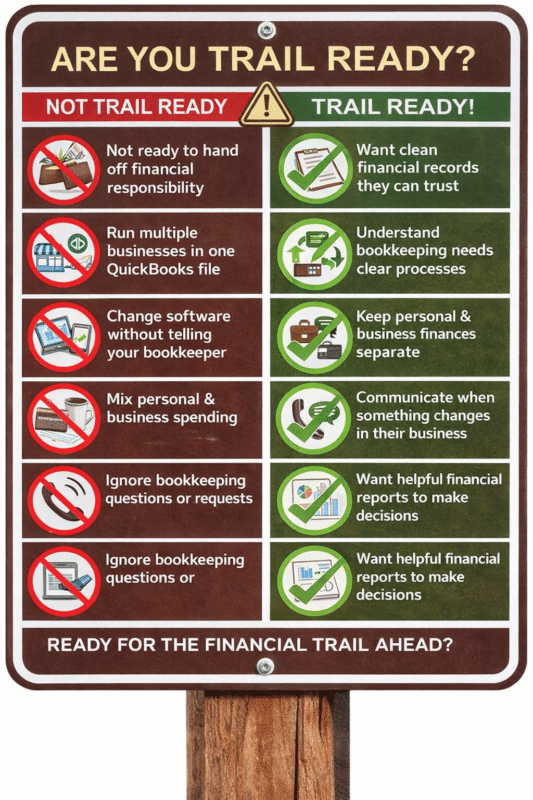
- You are not ready to hand off financial responsibility
- You run multiple businesses inside one QuickBooks file and don’t want to fix that
- You change software without communicating with your bookkeeper
- You mix personal and business spending
- You stop responding to bookkeeping questions or requests
If any of these patterns are happening in your business today, it may be better to address them before starting a bookkeeping relationship.
The Conversation That Sets a Partnership Up to Work
Before we work with anyone, we look for warning signs. Some business owners are simply not ready for this kind of partnership. Catching that early saves everyone time, money, and stress.
We believe that starting with honesty is the best way to build a relationship that actually works. That is why we have this conversation upfront, before a service agreement is ever signed.
The five signs below are not insults. They are honest warning signs. If you see yourself in any of them, it does not mean your business is broken. It just means this may not be the right time for this type of working relationship.
The owners who do belong here are the ones who treat their finances like a real business tool. They want clean numbers. They trust the process. They know that good records lead to better decisions. If that sounds like you, keep reading.
SIGN 1
You Are Not Ready to Hand Off Financial Responsibility
You built your business from scratch. Letting someone else handle your numbers can feel scary. That feeling makes sense. But it creates a real problem when working with a bookkeeper. You deserve a financial partner who does more than enter numbers.
When the right relationship is in place, your finances get organized, your records make sense, and you have the information you need to make smart decisions. That only happens when there is real trust on both sides.
If approving every entry feels necessary right now, the relationship will stall before it delivers any value to you. Getting accurate, useful financial reports requires room for the process to run. The owners who benefit most when hiring Amber’s Accounting & Bookkeeping are the ones who hand it off and let it work. The owners who get the most out of this relationship want a real financial partner. They are not looking for someone to just enter data.
SIGN 2
You Are Running Two Businesses in One QuickBooks File
This one catches people off guard. It is one of the most common problems we see. A business owner buys a building and runs their business out of it. Instead of keeping two separate sets of records, they try to squeeze both into one QuickBooks account. QuickBooks Online is built for one business.
One EIN. One LLC. One S-Corp. One C-Corp. Forcing two businesses into one account creates records that cannot be trusted. Accounting rules require separate records for separate businesses. This is not a preference. It is a requirement. It protects the accuracy of your taxes, your reports, and your financial decisions.
If you want numbers you can trust, each business needs its own file.
SIGN 3
You Change Software Often, Without Communicating First
This happens more than you might think. A client switches payroll companies without saying a word. Or they connect a new tool to QuickBooks without asking how it works.
The records stop making sense and the errors are hard to trace. Every tool connected to QuickBooks changes how your transactions are recorded. One wrong setting creates errors that run through the entire file. Your books are only as accurate as the systems feeding them.
When a new tool connects the wrong way, your records break quietly and the errors are hard to find. A quick conversation before making that change protects the accuracy you are paying for. Before you add any new payroll system, software, or app to QuickBooks, bring us into that conversation first.
SIGN 4
You Mix Personal and Business Spending
This is the most common reason a bookkeeping relationship falls apart before it ever gets going.
Personal bills, personal purchases, personal subscriptions, all running through a business bank account or credit card. When we start with a new client who has this habit, we usually give them some time to move those charges to personal accounts. But that window does not stay open forever. Mixing personal and business spending creates problems in the records every single month.
Here is what that habit actually costs you:
- You pay for extra bookkeeping hours to sort through the mess
- Your expenses are more likely to be put in the wrong category
- Tax prep takes longer and costs more
- Your financial reports cannot be trusted for real decisions
- You deal with more back-and-forth every month
Keeping personal and business spending separate is not optional. It is the starting point.
SIGN 5
You Get Pulled Away and Communication Slips, or Worse- Stops
This kind of relationship does not run on autopilot. We check in every month. We ask questions. We flag things that need your attention. When a client stops responding, the work stops too.
If we cannot get an answer, we cannot record a transaction correctly. If the records fall behind, you can end up with late fees, wrong reports, and eventually a terminated service agreement. Staying in the loop takes less time than most owners expect.
Once things are set up, most clients spend under 30 minutes a month responding to questions and sending over documents. That small investment keeps your records clean, your reports accurate, and your finances moving in the right direction. If staying responsive is hard for you right now, this type of structured service may not be the right fit.
What Happens When These Problems Are Ignored
The cost of a bad fit adds up fast. Mixed spending creates extra work that shows up on your invoice. Software errors delay your monthly reports. Going silent pushes your records further behind every week.
These are real outcomes that real business owners faced when these patterns went unaddressed:
- A business owner who stopped responding to monthly check-ins ended up three months behind on their records. They missed the year-end close and filing 1099s on time, starting the new year behind with unresolved books.
- A business owner who kept mixing personal and business spending received a large cleanup invoice. The cost of untangling those records was not only financial. It was a lot of time wading through transactions to separate them and a large tax bill because those were not true tax deductions.
- A business owner who connect a CRM app to QuickBooks without communicating created a lot of errors inside of QuickBooks. The mappings were done incorrectly which affected the accounts receivable totals and collectable invoices. That could have been avoided with one conversation.
Every one of those situations could have been avoided.
Catching a bad fit early protects everyone. A good bookkeeping partnership runs on trust, clear communication, and clean financial habits. When those are in place, your records stay accurate, your reports are useful, and your finances support the decisions your business needs you to make.
Who This Type of Bookkeeping Partnership Is Right For
They:
- Want clean financial records they can trust
- Understand that bookkeeping requires clear processes
- Keep personal and business finances separate
- Communicate when something changes in their business
- Want financial reports that help them make better decisions
When these habits are already in place, bookkeeping becomes much more valuable. The numbers stay clean, the reports are reliable, and the business owner can actually use their financial information to guide decisions.
Frequently Asked Questions
What does it mean to hand off my bookkeeping to someone else?
It means letting a professional manage, organize, and report your financial records without needing your sign-off on every single entry. You stay involved in the big decisions. You step back from the day-to-day work of tracking transactions.
Why can’t I run two businesses inside one QuickBooks Online file?
QuickBooks Online is built for one business at a time. Mixing two businesses in one file creates records that break accounting rules and cannot be used for taxes, loans, or reliable financial decisions.
How much time will I spend communicating with my bookkeeper each month?
Most clients spend less than 30 minutes a month once everything is set up. We ask questions and request documents when needed. A quick response keeps everything on track.
How do I know if I am mixing personal and business expenses?
If personal bills, subscriptions, or purchases show up in your business bank account or credit card, the mixing has already started. The fix is to move those charges to a personal account and stop adding new ones to the business side.
What happens if I add a new software tool to QuickBooks without telling my bookkeeper?
The new tool may connect to QuickBooks the wrong way. That creates errors in your records that take time to find and fix. That extra time comes back to you as an added cost.
In Summary:
A bookkeeping relationship works when both sides show up. That means handing off responsibility, keeping finances clean, staying in touch, and looping us in before making system changes. When those things happen, your records stay clean and your numbers can be trusted. These five signs are not meant to push you away. They are meant to help you be honest with yourself before spending time and money on a relationship that may not be ready to work. The right fit is good for everyone. The wrong fit wastes everyone’s time.
If this type of partnership sounds like what your business needs, the next step is simple. Visit the Contact Us page at Amber’s Accounting & Bookkeeping and book a free 30-minute Zoom call with Amber. That call helps both sides decide if it is a good fit before anyone commits to anything.